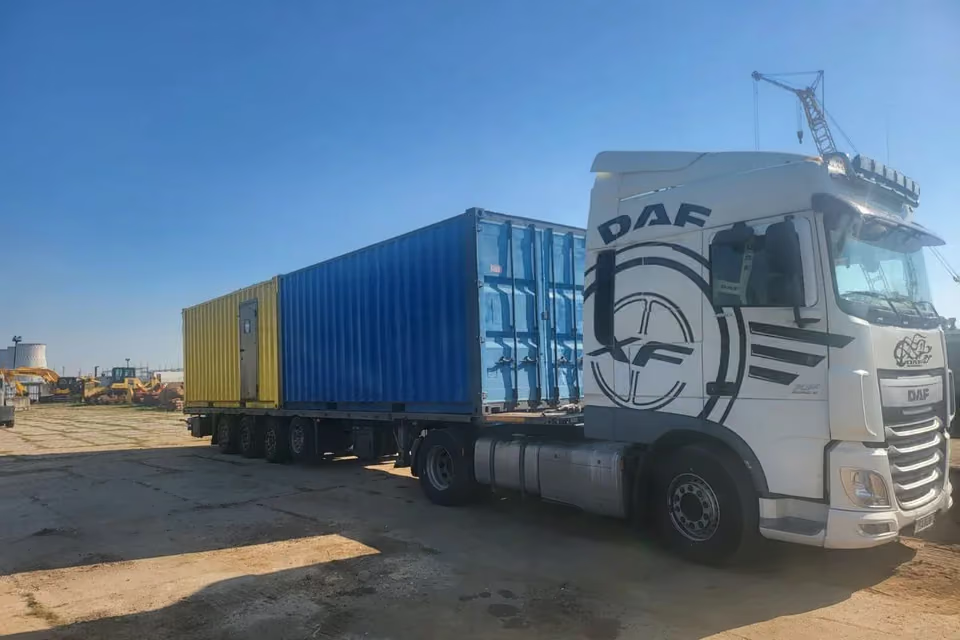
What Makes Up the Cost of Shipping Cargo from China to Belarus
A breakdown of a China–Belarus logistics quotation: cargo pickup, consolidation, the main freight leg, transshipment, customs-related costs, delivery and contingencies.
June 7, 2026 · 10 min read
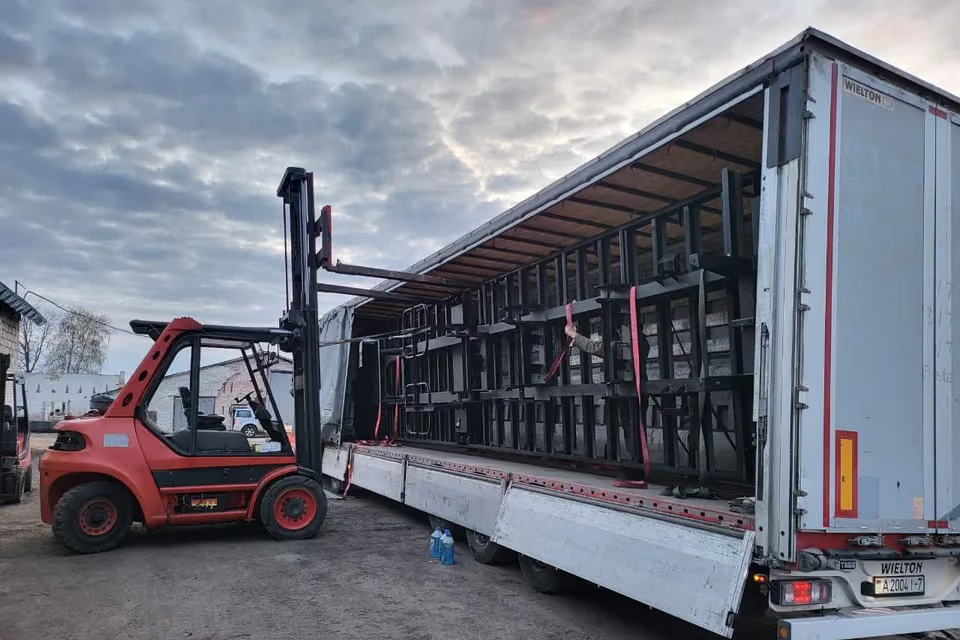
A breakdown of a China–Belarus logistics quotation: cargo pickup, consolidation, the main freight leg, transshipment, customs-related costs, delivery and contingencies.
Define the quotation scope first
“Shipping from China to Belarus” can cover very different scopes of work. One quotation may apply only from the origin terminal to the destination terminal. Another may include factory pickup, export customs clearance, the international freight leg, customs transit and delivery to the buyer’s warehouse. The figures cannot be compared until the origin and destination points, delivery terms, shipment format and responsibility for each operation are aligned.
A cargo specification is the basis of the quotation request. It should state the shipper’s and consignee’s addresses, cargo description, commodity code if available, number of packages, dimensions, gross weight, packaging type, value, cargo-ready date and any special characteristics. Equipment requires drawings; liquids, chemicals and batteries require technical documents needed to verify carriage conditions. The more accurate the input data, the fewer provisional assumptions and contingencies need to be built into the rate.
Information to include in a quotation request
- exact loading and unloading addresses, contact details and site conditions;
- the contractual delivery term and allocation of costs;
- the weight, volume and dimensions of each cargo package;
- the preferred dispatch window and acceptable transit-time range;
- whether consolidation, insurance, customs support and door delivery are required;
- temperature, handling, marking and cargo-compatibility requirements.
Origin costs in China
Before the international freight leg, origin costs may include factory pickup, site-entry charges, waiting time, loading, weighing, additional packaging and origin haulage to a consolidation warehouse or terminal. Groupage shipments also require cargo acceptance, verification of the number of packages, storage within the agreed allowance, palletization and consolidation. When several suppliers are involved, routing within China and coordination of cargo-ready dates become separate items in the quotation.
Responsibility for export formalities must also be assigned. Depending on the contract, the documents may be prepared by the supplier, its agent or an appointed logistics operator. If the cargo description in the invoice does not match the actual packaging, correcting it before dispatch is generally safer than making amendments at the border. A low pickup rate therefore does not guarantee a low final total: document-related delays can lead to storage charges, vehicle detention and rebooking.
Shipment format and the main freight leg
On the international freight leg, the cost depends on the transport mode and how capacity is utilized. With a dedicated vehicle or container, the customer pays for the allocated transport unit and related operations. For groupage cargo, the operator allocates costs among shipments based on its rules, taking into account weight, volume, loading length and the characteristics of each cargo package. Dividing one shipment’s total rate by its kilograms therefore does not provide a reliable price for another shipment.
Road, rail and multimodal solutions have different cost structures. In addition to line-haul freight, the quotation may include terminal handling, transshipment, positioning of transport equipment, documentation, transit operations and last-mile delivery. A route with a lower rate may require more transshipments or offer narrower departure windows. For a business, the relevant measure is not abstract “cheapness” but the cost of meeting the required schedule at an acceptable level of risk.
Bystrox · Belarus and China
Calculate route and cost
Share the cargo details, route points, and target dates. Our team will clarify the requirements and propose a workable transport plan.
Surcharges that change the final total
A rate may be valid only for a limited period because transport capacity and the availability of terminals and border infrastructure change. Waiting during loading, storage, vehicle detention, repeat vehicle positioning, inspection, additional loading work and customer-requested route changes are addressed separately. This does not mean every event will occur; the purpose of the quotation is to define the calculation basis in advance and identify which party bears the cost if an event occurs.
Out-of-gauge, dangerous, temperature-controlled or high-value cargo may require specialized transport, compatible co-loading, additional packaging, permits or separate insurance. These items should not be hidden in a single general charge: the customer needs an itemized list of assumptions and requirements. If a cargo characteristic becomes known only after the rate has been confirmed, the carrier may recalculate the transport solution because both the cost and the feasibility of carriage may have changed.
Customs payments and ancillary services
The logistics rate is not the same as the full landed cost of an import. Customs duties, taxes and fees, as well as services related to declaration, temporary storage, inspection or verification of product characteristics, are assessed separately from logistics charges. The calculation depends on the commodity classification code, customs value, origin, customs procedure and applicable regulatory measures. Applying a single percentage to all goods is incorrect.
Customs value is determined under the applicable valuation method and on the basis of supporting documents. Transport and other costs are included according to the rules applicable to the specific shipment. Before signing the contract, it is useful to prepare a full landed-cost model covering the goods, seller’s and buyer’s costs, international logistics, customs payments, customs-clearance services and domestic delivery. The final legal and tax treatment should be confirmed with qualified specialists as of the transaction date.
How to compare quotations without hidden assumptions
- align all quotations to the same route and responsibility boundaries;
- check the rate currency, validity period and recalculation method;
- identify which terminal operations are included and excluded;
- compare free-time allowances and the terms for waiting, storage and detention;
- confirm the number of transshipments and how cargo integrity will be controlled;
- separate fixed quoted items from costs charged as incurred;
- compare the planned scenario with a deviation scenario.
A sound commercial quotation makes the pricing logic traceable. It shows the input data, route, transport mode, service scope, exclusions and validity period. If a quotation states only a final total, request an itemized cost breakdown before confirming it. This approach also benefits the carrier by reducing the risk that the parties’ expectations diverge after the cargo has already been accepted for handling.
Key points in 30 seconds
- An accurate shipping cost includes every operation from the supplier’s address to the agreed destination, not just the main carrier’s line-haul rate.
- The main cost drivers are the route, shipment format, weight and volume, cargo characteristics, seasonal capacity and the number of transshipments.
- Quotations are comparable only when they cover the same service scope, currency, payment terms and included charges.
- Customs payments and taxes are calculated separately based on the commodity code, customs value and rules in force; there is no universal percentage for all cargo.
Questions on this topic
Why does the price per kilogram differ for two similar shipments?
The price depends not only on weight but also on volume, cargo-package dimensions, route, co-loading compatibility, terminal operations and available capacity on the dispatch date.
Is customs duty included in the freight cost?
It is usually calculated separately. Always check the scope of the specific quotation: logistics charges and customs payments are separate cost items.
Can the final cost be confirmed in advance?
The calculation can be fixed once the data and conditions are confirmed, but any costs charged as incurred must be identified in advance. A change to the cargo or route requires recalculation.
What matters more when comparing offers: the rate or transit time?
Compare the cost of meeting the business requirement as a whole: price, realistic transit time, number of handling operations, risks and the consequences of schedule deviations.
Need a route quote?
Share cargo details and deadlines — we will propose a transport plan and commercial offer.