Container freight from China to Belarus
FCL, LCL, 20’, 40’ and 40HC
How to choose the container shipping format from China to Belarus, evaluate the usable capacity, costs, route and loading requirements.
April 3, 2026 · 10 min read
How to choose the container shipping format from China to Belarus, evaluate the usable capacity, costs, route and loading requirements.
FCL and LCL: two different processes
Full container load (FCL) allocates a container to one shipment, although the container need not be filled to its last cubic metre. The shipper has greater control over stowage, packaging and sealing, and individual cargo pieces usually undergo fewer handling operations. FCL suits large shipments, regular imports, heavy cargo and goods that should not be loaded with other consignments.
LCL means less-than-container load. Small consignments from several customers are collected at a consolidation warehouse, loaded into one container and separated after the main transport leg. The customer pays for the space used and the associated handling. LCL must not automatically be called LTL: less-than-truckload (LTL) refers to a shipment that uses only part of a truck's capacity. Container and road-freight consolidation involve different terminals, documents, schedules and risks.
When to consider FCL
- The shipment occupies a substantial share of the container or approaches its weight limit.
- The cargo is fragile, high-value, non-standard or incompatible with neighbouring consignments.
- Fewer handling operations for individual cargo pieces and control over sealing are important.
- Deliveries are regular and can be planned in container lots.
20’, 40’ and 40HC: how they differ in practice
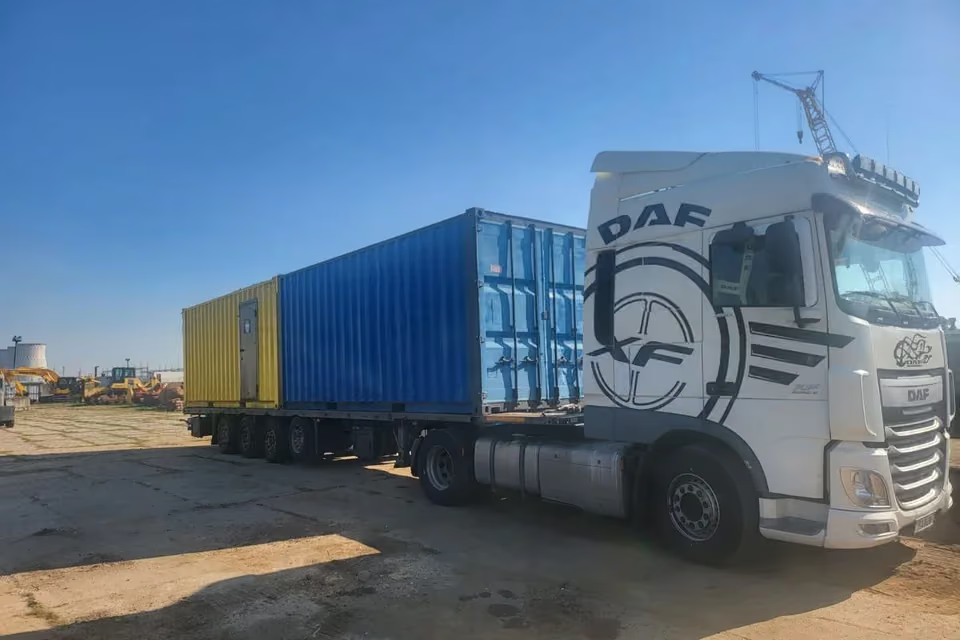
A 20-foot container is shorter and often suits compact, heavy cargo. A 40-foot container provides more length and internal volume. A 40HC, or High Cube, provides additional height and can suit bulky, relatively light goods. Exact internal dimensions, door opening, tare weight and permissible gross weight depend on the operator’s equipment, so planning must use the specifications of the allocated container rather than an average table found online.
A larger container is not always more economical. The weight limit may be reached before the volume limit, and tall cargo may not pass through the door even when the internal height is sufficient. Road legs are subject to gross-weight and axle-load limits, while terminals impose handling requirements. Heavy or uneven shipments require a load-distribution plan. A standard container may be unsuitable if the cargo exceeds its normal envelope or requires open transport equipment.
Load and packaging calculations
Calculate each cargo piece separately: length, width, height, weight, orientation, stackability and permissible top load. Cubic volume alone is insufficient. Two sets of cartons with the same volume may use space differently because of pallets, clearances and “this way up” restrictions. For machinery, account for the centre of gravity, securing points and safe access for a forklift or crane.
Packaging must withstand the route, humidity changes, vibration, handling and the time spent in a closed container. Wood packaging used in international trade may be subject to ISPM 15 phytosanitary requirements; applicability and evidence of compliance must be checked before dispatch. Assess moisture barriers, desiccants and ventilation against the cargo’s properties to control condensation. No universal quantity of desiccant can be specified without calculation.
Bystrox · Belarus and China
Calculate route and cost
Share the cargo details, route points, and target dates. Our team will clarify the requirements and propose a workable transport plan.
What does the route to Belarus consist of?
The container can be transported by rail, sea followed by rail or road transport, or some other combination. In any option, there is collection from the supplier, acceptance by the terminal or consolidation warehouse, main transport leg, transit operations and delivery to the recipient. With LCL, consolidation and deconsolidation are added. With FCL, the container may remain closed longer, but control authorities have the right to order an inspection.
Transit time depends on cargo and document readiness, schedules, container and service capacity, terminal congestion, border operations and final delivery. Plan a time range and milestone dates rather than one fixed date. For deliveries to production start, the reserve is calculated from the required date at the site back, including clearance and internal acceptance, and not just international transit.
Total cost and variable costs
The base rate often covers only part of the chain. The quotation should identify supplier collection, export handling, the LCL consolidation warehouse, terminals, main carriage, transshipment, delivery within Belarus and insurance. Confirm equipment free time, storage, detention, inspections, redirection and empty-container return separately. Charge names and rules vary by operator and route.
Questions for a like-for-like quotation
- Whether the rate is for FCL or LCL, and which charging unit applies.
- Which locations and operations are included, and which are charged at actual cost.
- What type of container is provided and who confirms its suitability.
- How long the offer is valid and what components depend on the currency or season.
- What are the rules for free time, storage and return of equipment.
- Who takes out the insurance and what risks, exclusions and deductibles apply.
Documents, loading and acceptance
Before collection, verify the contract, commercial invoice, packing list and transport instructions: party names, number of cargo pieces, weight, marks and cargo description. The required permits depend on the product’s classification and intended use; confirm the list with a customs representative. The carrier can help guide the process, but should not pass off a commercial opinion as a legal opinion.
For FCL, photograph the empty container, stowage process, securing arrangements, closed doors and seal. For LCL, record the condition and marks of every cargo piece before handover to the warehouse. The consignee prepares the site, handling equipment and personnel in advance to avoid chargeable waiting time. On arrival, check the seal and documents, inspect the packaging before moving the cargo and record any discrepancy immediately under the contractual procedure.
Key points in 30 seconds
- Full container load (FCL) allocates a container to one shipment; less-than-container load (LCL) uses part of a container consolidated with cargo from other shippers.
- A container’s nominal volume is not fully usable: door dimensions, weight limits, packaging and the stowage plan all impose constraints.
- Choose between 20-foot, 40-foot and 40HC containers by considering volume, weight and cargo geometry, not container price alone.
- The total cost includes local transport legs, terminal charges, transshipment, storage and equipment use.
Questions on this topic
Which is more economical: FCL or LCL?
It depends on volume, weight, route and handling costs. As shipment size grows, a dedicated container may become more economical, but the crossover point must be calculated from current rates and cargo characteristics.
Is it possible to fill a container to its nominal capacity?
Usually not in full. Packaging, pallets, clearances, the door opening, securing arrangements and weight limits reduce usable capacity.
Is 40HC always better than regular 40’?
No. The additional height benefits bulky cargo but does not remove constraints relating to weight, door dimensions, route or loading method.
Who determines the required customs documents?
Confirm the list from the goods code, characteristics and intended use with a customs representative and, where necessary, the competent authorities.
Need a route quote?
Share cargo details and deadlines — we will propose a transport plan and commercial offer.