Road, rail or multimodal freight from China to Belarus
which option should you choose?
A practical comparison of road, rail and multimodal freight from China to Belarus by transit time, cost, operational control and cargo requirements.
March 8, 2026 · 10 min read
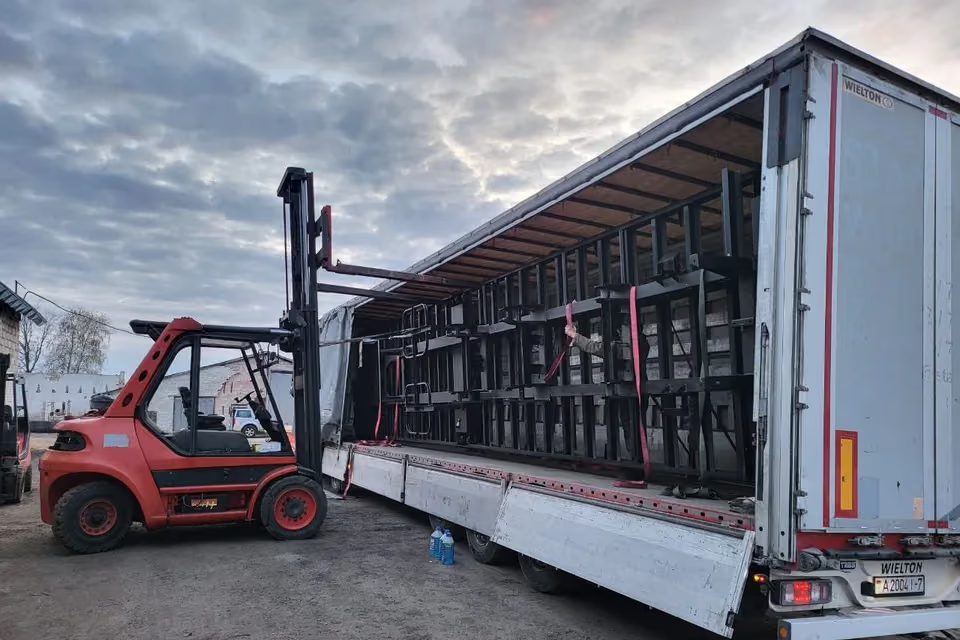
A practical comparison of road, rail and multimodal freight from China to Belarus by transit time, cost, operational control and cargo requirements.
Start with shipment requirements, not the transport mode
There is no universal answer to whether road, rail or multimodal freight is best. One shipment may require a truck to be positioned quickly at the supplier; another may need reliable container departures; a third may prioritise cost because ample lead time is available. First record the cargo-ready date, collection address, delivery point in Belarus, number of cargo pieces, weight, volume, value and handling requirements. Then define the latest acceptable arrival date and the financial consequences of delay: a production stoppage, a stockout, an idle installation crew or simply higher inventory.
Compare quotations on the same scope of service. A rate to a terminal is not equivalent to delivery to the consignee’s warehouse. The calculation may include collection from the supplier, export formalities, terminal handling, transshipment, transit, insurance, storage, final delivery and equipment return. Assess customs payments and mandatory permits separately with a customs representative or other relevant specialist. A carrier’s commercial recommendation does not replace the legal classification of the goods.
Baseline data for comparison
- Name and purpose of the product, HS code if there is a verified classification.
- Supplier address, the Incoterms® rule stated in the contract and the exact destination.
- Number of cargo pieces, packaging type, dimensions, gross weight and stackability.
- Requirements for temperature, hazard, fastening, protection from moisture and handling loads.
- Cargo-ready date, preferred delivery window and acceptable time buffer.
When road freight is the practical choice
Road freight is valued for its first- and last-mile flexibility. A truck can collect directly from the supplier and, where the route and contract permit, deliver to the consignee’s warehouse without terminal transshipment. This mode suits urgent consignments, equipment, non-standard cargo and collections far from a suitable rail terminal. Full truckload (FTL) uses a dedicated vehicle for one shipment. Less-than-truckload (LTL) combines compatible consignments from several customers in the same vehicle.
Flexibility does not guarantee a fixed transit time. Actual timing depends on truck positioning, route restrictions, border queues, inspections, weather and warehouse opening hours. Price depends on the vehicle body type, weight and volume, urgency, seasonal equipment balance, additional permits and insurance terms. For production-critical cargo, build a buffer into the schedule, agree milestones and define in advance what to do if the route changes.
Strengths and weaknesses of the railway
Rail freight is generally considered for planned shipments that can fill a container or move as part of a consolidated container load. Full container load (FCL) allocates a container to one shipper or shipment. Less-than-container load (LCL) combines consignments from different customers in one container. LCL is a container-freight term, whereas LTL applies to road freight; they describe different transport units and are not interchangeable.
Rail freight fits well into a regular procurement schedule, but the route also includes terminals, container handling and road legs before and after the rail movement. Transit time depends on departure schedules, wagon and container availability, train formation, transshipment where track gauges change, terminal queues and document checks. For a like-for-like comparison, confirm whether the quote includes the origin and destination stations, terminal charges, storage, demurrage and other equipment-use charges.
Bystrox · Belarus and China
Calculate route and cost
Share the cargo details, route points, and target dates. Our team will clarify the requirements and propose a workable transport plan.
What a multimodal solution offers
Multimodal transport combines two or more modes, such as road and rail, or sea, rail and road. Its value lies not in the number of stages but in connecting a remote factory to a suitable corridor and managing constraints across different legs. It can suit planned volumes, cargo from China’s coastal provinces and cases where a direct service is constrained by capacity or cost.
Every transshipment adds a handling operation, a document and a potential delay point. Before booking, define who coordinates the transport legs, how participants exchange information, where responsibility transfers and which evidence is issued if damage occurs. A single contract may simplify communication, but its terms still matter: liability is governed by the contract, applicable conventions and law, not by the service’s marketing name.
How to Compare Cost and Time Without False Precision
Request several quotations for the same date and shipment data. For each option, separate the base rate, local charges in China, transit and terminal operations, delivery within Belarus, insurance and any variable charges. Present timing as a range covering collection waiting time, the main transport leg, terminal handling, customs clearance and final delivery. An unqualified promise of one arrival date does not reflect an international supply chain.
Checking the carrier's offer
- Are the start and end points of the service the same in all options?
- Which costs are fixed, which are recalculated and how long the rate is valid.
- How many transshipments are planned, and how is the cargo protected during each one?
- Which documents must the shipper provide before the vehicle or equipment is positioned?
- How often the status is reported and what happens if there is a deviation from the plan.
- Which exclusions and liability limits apply under the contract and insurance policy.
Practical selection and contingency-planning model
For an urgent shipment with high downtime costs, operational control and fewer transshipments often take priority, which may favour a dedicated truck. Rail freight is worth assessing for regular container flows with predictable consumption. Multimodal corridors may suit large planned shipments with flexible schedules. The decision should nevertheless follow a shipment-specific quotation and a check of cargo restrictions. Batteries, chemicals, food products, equipment containing fuel and dual-use goods may require special preparation or may be unavailable on certain route sections.
A resilient transport plan normally includes an ordering calendar, a time buffer, document-readiness checks and a contingency option. Rather than changing modes for every shipment, define the conditions that trigger a switch. Planned deliveries can use the standard route while the shortage portion moves by an expedited service. This controls total cost without turning every deviation into an urgent transport booking.
Key points in 30 seconds
- Select a transport mode based not on a single rate, but on the total logistics cost, acceptable transit time and consequences of delay.
- Road freight usually provides greater flexibility, rail is well suited to planned container flows, and multimodal transport broadens the range of routing options.
- Transit times and rates vary with the season, terminal congestion, border conditions, equipment availability and cargo characteristics.
- Regular importers should define both a primary and a contingency transport plan in advance.
Questions on this topic
What is the fastest delivery method from China to Belarus?
Road freight is often selected for urgent shipments, but actual transit time depends on the loading point, truck availability, border conditions, route and document readiness. Compare current quotations for the specific cargo.
Is rail freight always cheaper than road freight?
No. The result depends on shipment volume, the stations used, local transport legs, terminal charges, season and equipment availability. For a small shipment, the total cost of the rail solution may be uncompetitive.
Can the arrival date be guaranteed?
International transit is affected by external factors, so agree an estimated time range, milestones and a buffer. The contract determines the legal effect of any delivery commitment.
How is LCL different from LTL?
LCL uses part of a container, while LTL uses part of a truck’s capacity. Both involve consolidation, but their processes, equipment and pricing differ.
Need a route quote?
Share cargo details and deadlines — we will propose a transport plan and commercial offer.