Transporting cranes and crane equipment from China
how to prepare the project
A practical guide to preparing the transport of a truck, tower or crawler crane from China: input data, dismantling, securing, routing and documentation.
May 25, 2026 · 10 min read
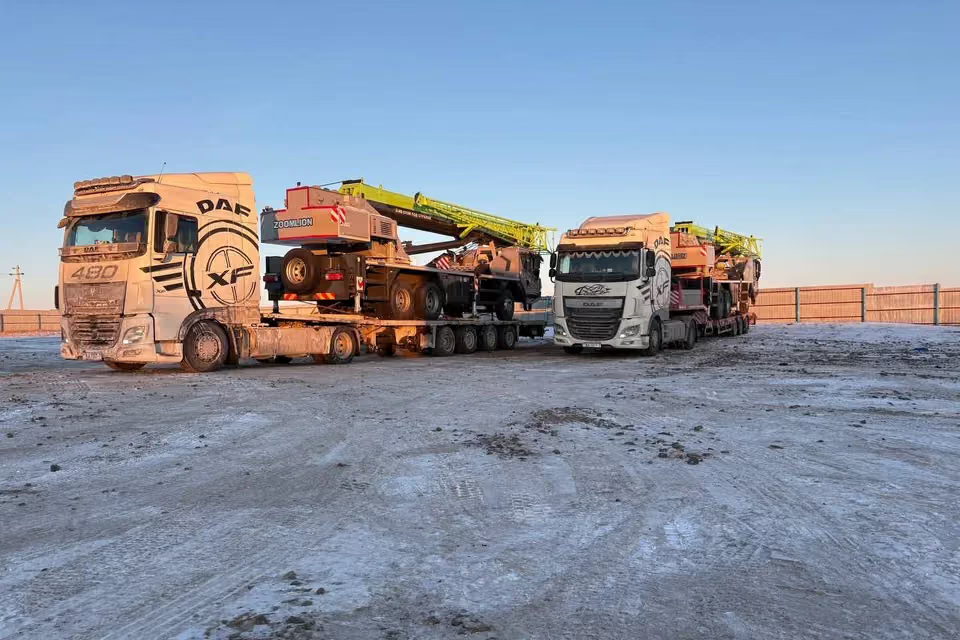
A practical guide to preparing the transport of a truck, tower or crawler crane from China: input data, dismantling, securing, routing and documentation.
Where a crane transport project begins
A crane cannot be assessed accurately from its model designation and catalogue total weight alone. A logistics project requires the transport data for the exact configuration: the actual weights of the base machine, boom, counterweights, jib, hook blocks, supports and spare parts. Catalogue figures are useful for a preliminary estimate, but before transport is booked they must be cross-checked against the packing list, factory specification, photographs and measurements taken at the site in China.
At the outset, the importer defines the limits of each party's responsibility. The project must state in writing who will dismantle the assemblies, provide lifting equipment, fabricate supports, pack sensitive components, load the trailer and prepare the export documents. Incoterms delivery terms help allocate costs and risks between seller and buyer, but they do not in themselves replace a technical specification for loading and securing.
Input data required for a preliminary assessment
- equipment model, serial number, condition and intended use;
- the manufacturer's general arrangement drawing and transport diagrams;
- the weight and dimensions of each cargo package after dismantling;
- the loading site's address, operating hours and technical capabilities;
- the delivery point, site-access restrictions and unloading method;
- a list of service fluids, batteries and other regulated components.
How to determine the transport configuration
A truck crane may travel as a complete machine if its condition, documents and route permit, or it may be carried on a low-loader. Tower and crawler cranes are normally separated into sections and assemblies. The project's technical team decides what must be dismantled in accordance with the manufacturer's instructions: a logistics specialist should not propose removing components when the lifting points, securing sequence and reassembly requirements are unknown.
Separating more assemblies makes it easier to reduce the dimensions of the main unit, but increases the number of cargo packages, handling operations and the risk of parts being mixed up. Each package is assigned a number, photographed before packing, and marked with its centre of gravity and lifting points. Cabs, hydraulic cylinders, electronic equipment and exposed connections must be protected against moisture and mechanical damage. Counterweights and boom sections should not be treated as ordinary supplementary cargo: their placement affects axle loads and the stability of the vehicle combination.
Selecting the transport equipment and checking the route
Once the cargo package schedule has been prepared, the carrier models the complete vehicle combination. Trailer deck height is added to cargo height, and the weight of the securing equipment and handling fixtures is included in the gross weight. The proposed route is then checked for turning radii, overhead clearances, passage widths, axle loads, transshipment points and terminal conditions. If the parameters exceed ordinary road limits, the route and required permits are determined separately for each jurisdiction.
Direct road transport reduces the number of transshipments, but it is not always available for a large assembly. Containers or rail may be suitable for sections, spare parts and equipment that fit within the permitted parameters of the selected transport unit. A combined solution can sometimes be more practical: the main machine travels on a platform trailer, while dismantled components are shipped separately as standard or containerised cargo. Options should be compared by total cost, number of handling operations and how controllable the risks are, not solely by the rate for one leg.
Bystrox · Belarus and China
Calculate route and cost
Share the cargo details, route points, and target dates. Our team will clarify the requirements and propose a workable transport plan.
Loading, supporting and securing the cargo
Before the vehicle arrives, the parties agree how the crane will be driven or lifted onto the trailer, the capacity of the lifting equipment available on site, and the loading sequence for the cargo packages. The securing plan must account for the centre of gravity, load distribution, designated securing points and the manufacturer's prohibitions. Chains, webbing straps, chocks and dunnage are selected for the specific cargo and vehicle. Using hydraulic components, handrails or arbitrary holes as securing points without the manufacturer's confirmation is dangerous.
After loading, the position of the equipment and the condition of all visible surfaces are recorded. A useful evidence package includes an overall view of the vehicle combination, every securing point, seals, cargo-package markings and weight readings where weighing has been performed. The same controls must apply during transshipment at a terminal: the responsible party checks the package numbers and reports any changes to the plan. For a complex project, the person authorised to stop an operation when it deviates from the approved plan is designated in advance.
Documentation and customs preparation
The commercial contract, invoice and packing list must describe the equipment consistently. The descriptions, models, serial numbers, quantities, values and weights must not conflict with the technical documentation or transport consignment note. For a used crane, the documents confirming origin, year of manufacture, condition and conformity-assessment requirements should be checked in advance. The need for permits is determined by the commodity code, characteristics and declared customs procedure, not by the everyday label “crane”.
The commodity classification and the required supporting evidence should preferably be checked before payment and shipment. Depending on the actual supply and applicable rules, individual assemblies may be declared together with the machine or as separate goods. The declarant, working with the relevant specialists, makes the legally significant decision on the basis of the documents. This article does not replace a classification decision, a conformity assessment or verification of the restrictions in force on the import date.
Pre-dispatch control checklist
- cross-check the specification, photographs and actual measurements for every cargo package;
- approve the dismantling, marking, packing and reassembly plan;
- calculate the transport dimensions and weights of the complete vehicle combination, including axle loads;
- check the route, terminals, transshipments and current permit procedures;
- agree the loading and securing plan with all responsible parties;
- resolve discrepancies among the contract, invoice, packing list and technical documentation;
- document the acceptance procedure, photo-reporting requirements and actions to be taken if deviations occur.
The best time to identify a problem is before the crane leaves the factory. Changing the platform, route or composition of the cargo packages after the move has begun usually affects several links at once: permits, bookings, customs data and the transshipment schedule. The working project file should therefore carry a date, identify the responsible parties and list the confirmed input data. If the supplier changes the configuration, the calculations must be repeated.
Key points in 30 seconds
- The project starts not with vehicle selection, but with checking the drawings, actual dimensions, the weight of each cargo package and whether the crane can be dismantled safely.
- Transport dimensions must be calculated for the complete vehicle combination: cargo, supports, securing equipment, trailer and tractor unit.
- The route, transshipments, permits and documents should be coordinated as one continuous chain before the equipment leaves the supplier's premises.
- Exact requirements depend on the crane's design, the transit countries and the rules in force, so the final transport plan must be verified as of the dispatch date.
Questions on this topic
Can transport be calculated from the crane model alone?
Only as a preliminary estimate. Selecting the vehicle and route requires actual dimensions, weight, configuration, a dismantling plan and the loading conditions.
Is a crane always classed as an oversized load?
No. The assessment is based on the parameters of the specific cargo together with the vehicle and on the rules of every country along the route.
Who prepares the cargo securing and lashing plan?
Responsibility is assigned by contract. The plan must be based on the manufacturer's data, the vehicle's characteristics and the applicable safe-securing standards.
Does a used crane require certification?
The answer depends on the commodity code, characteristics, intended use and applicable requirements. It should be checked before purchase against the documents for the specific machine.
Need a route quote?
Share cargo details and deadlines — we will propose a transport plan and commercial offer.